
Fires in Spokane highlight preparation needs in Montana
Keila Szpaller
ALBERTON (Daily Montanan) – Clean out gutters. Secure mesh screens over attic vents. Avoid planting junipers around the house.
Those are a handful of recommendations professionals who help Montanans prepare for wildfire offered this week for property owners.
Tim Laroche, wildfire mitigation program manager for Missoula County, said a cultural shift is underway to help property owners and homeowners think about wildfires in a different way.
“They have been told for 100 years that they don’t really need to do anything because firemen will put the fires out,” Laroche said. “Now, they’re starting to come to terms with the reality that that can’t happen all the time.”
Montana and the West are experiencing more wildfires and larger blazes than in decades past including in more urban and suburban areas.
In Spokane, a recent wildfire complex destroyed more than 900 structures including many homes, according to the Spokesman-Review.
Residents of the Treasure State already are living with the risk of wildfire, but the destruction in Washington prompted heightened interest from Montanans seeking ways to protect themselves.
Commissioner of Securities and Insurance James Brown said this week homeowners in Ravalli and Flathead counties in particular are seeing high rates of insurance nonrenewals “due to perceived wildfire risk.”
Brown said the state is in the western region of four regions designated by the National Association of Insurance Commissioners, and it has seen the highest increase in average homeowner premiums — 74% from 2018 to 2024 or 44% adjusted for inflation.
“We need to respond to the fact that Montana is becoming drier and conditions are becoming more ripe for wildfire loss,” Brown said.
He and other political leaders and wildfire professionals are responding with policy recommendations and tips for property owners.
Small steps to protect from wildfire
Embers are responsible for 90% of the structures destroyed by wildfire, according to a Missoula County fire preparation site.
Adriane Beck, director of the Office of Emergency Management for the county, pointed out one hint people can use to protect their homes.
“On a windy day, where do the leaves collect near your house? That’s the exact same place the embers are going to collect,” Beck said.
Olivia Anderson, also with the county’s wildfire mitigation program, said fire professionals focus on three areas where homeowners can take steps to prevent ignition.
The state Department of Natural Resources and Conservation offers similar recommendations.
Within 5 feet of the home: Take out flammable vegetation, clear gutters, clean roofs, cover vents with 1/8th-inch mesh, and remove wood mulch, wood piles, pine needles and patio furniture.
“The house and out to 5 feet is super, super important for mitigating for wildfire risk,” Anderson said.
From 5 feet to 30 feet: Remove shrubs and small trees, provide at least 18 feet of space between remaining shrubs and trees, and keep the area “lean, clean and green,” the county and DNRC recommend.
Out to 100 feet, people can thin trees to have a minimum 12 feet between tops, remove “ladder fuels” — flammable material that helps fires climb — and choose fire-resistant trees and shrubs, and clear vegetation near large propane tanks, the DNRC and county recommend.
The fires in Spokane weren’t “an aha! moment” for Missoula County, Beck said, but current policies and codes weren’t created through the lens of wildfire resilience.
“We can institute new policies and have new regulations that deal with how we grow in the future,” Beck said. “But we still have a significant underlying hazard.”
She said it takes individual homeowners to address the hazards, and in denser areas, it takes everyone together.
“It does take a whole community to have the scale of effective change that is needed, especially in situations where you are in more urban, densely populated areas,” Beck said.
In a 2025 report, Headwaters Economics said more than 1,100 communities in the country face wildfire risks similar to the ones Los Angeles faced then, and it identified nine in Montana.
Those are Whitefish, Bigfork, Missoula, Anaconda-Deer Lodge, Butte-Silver Bow, Big Sky, Livingston, Billings and Lockwood.
Grant money, home assessments available
Ashley Juran, with the Department of Natural Resources and Conservation, said the agency offers free home-risk assessments for wildfire, and calls picked up this month.
“Those requests have definitely gone up,” Juran said. “I think it’s a reflection of what occurred in Spokane as well as the consistent smoke in the air.”
Juran said money is not available for “home hardening,” or structure changes, but federal funding is available through the state to help a homeowner who needs help thinning or reducing fuel on the landscape.
“People are definitely tapping in and using it,” Juran said.
A DNRC resources page notes financial aid is available through partnerships with organizations and local governments.
Seeley Lake has been through wildfire, and Tom Browder, with the Seeley Lake Community Council, said he took advantage of the grant program probably 12 years ago.
“That program is still a good one,” Browder said.
He said it helped with thinning on his property, in an area with more trees. At the time, he paid a $4,000 bill, and he was reimbursed for $2,000, but the split is different now.
Laroche, with Missoula County, said one grant program for fuel reduction has the county pay 75% to a contractor, and the homeowner pay the other 25%.
Browder also recommended walking a property with a weed whacker or mower to take down tall grasses and bushes close to a house, cutting dead branches lower down, and moving wood racks off a patio in the summer.
He too said research shows “rivers of embers that flow through the air” are a huge cause of fires.
“You keep ignition sources from embers. You just don’t want them around the house,” Browder said.
Crews prepping properties to withstand fire
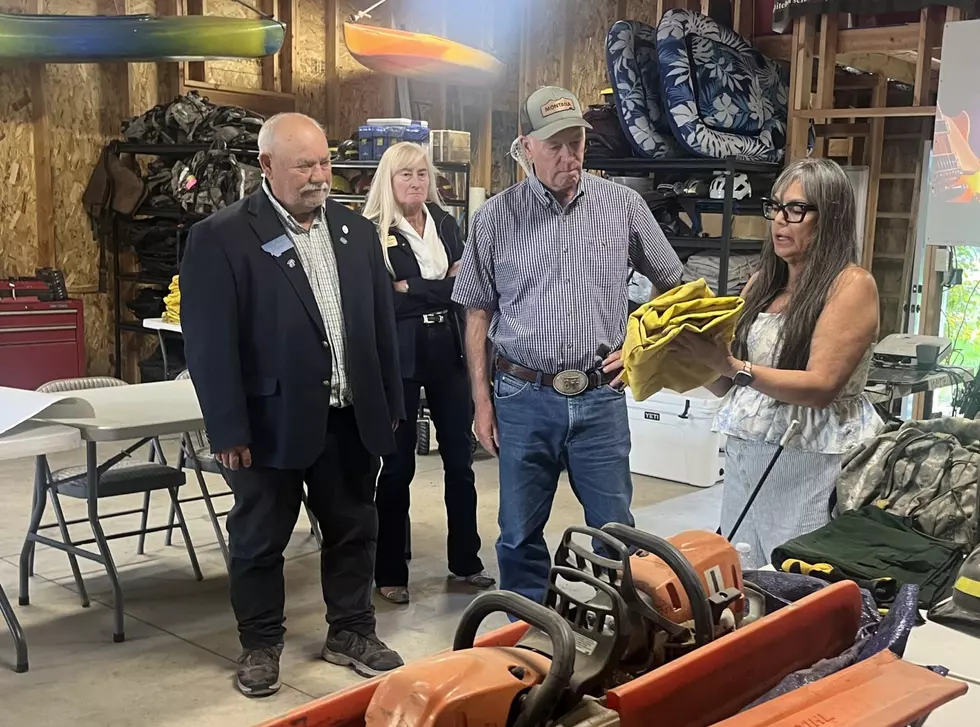
Wednesday in Alberton, AnnaMarie White talked with Gov. Greg Gianforte and community members about her business, White Horse Forestry.
White Horse Forestry’s work includes clearing land to make properties fire resistant, and its crews worked in Missoula County in the spring.
White said private landowners that hired the company are fine, but nearby U.S. Forest Service properties are burning.
“That’s just a pitch that everybody should mitigate, right?” White said.
Properties where her crews have worked went from being overgrown, with trees of small diameters close together, to being open.
“So sunshine is getting in,” White said.
She said she’s gotten more calls since the fires in Spokane because people are nervous.
Wildfire in the 2027 Montana Legislature
Montana values private property rights, so incentives for mitigation may be more palatable in many jurisdictions in the state than restrictions.
Brown said he’s getting more calls about the effects of wildfires, such as on property insurance, and he’s doing more outreach in Montana as a result.
He said his agency will be requesting a wildfire grant mitigation bill for the 2027 session that would support an insurance company to give a premium discount to a homeowner who does prevention on their property.
“Other states have successfully implemented that,” Brown said of similar legislation.
Rep. Paul Fielder, a Republican from Thompson Falls who serves as chairman of the interim Environmental Quality Council, said his committee has been studying wildfires.
He said it’s too early to tell whether it will back any related legislation, but he doesn’t believe it would support any zoning efforts.
“Most of Montana is free, and people can do what they wish with their property rights and live with whatever consequences they choose to live with,” Fielder said.
Wednesday, Gianforte kicked off the conversation in Alberton by reiterating his position on the role of government.
“I always say, ‘I’m with the government. My job is to stay out of the way,’” said Gianforte, a Republican.
Gianforte said the state offers services to help with fuel reduction, but the biggest incentive a homeowner has to protect their property isn’t one the state offers — it’s that their house doesn’t burn.
“I’m not sure how much more motivation you need,” Gianforte said.