
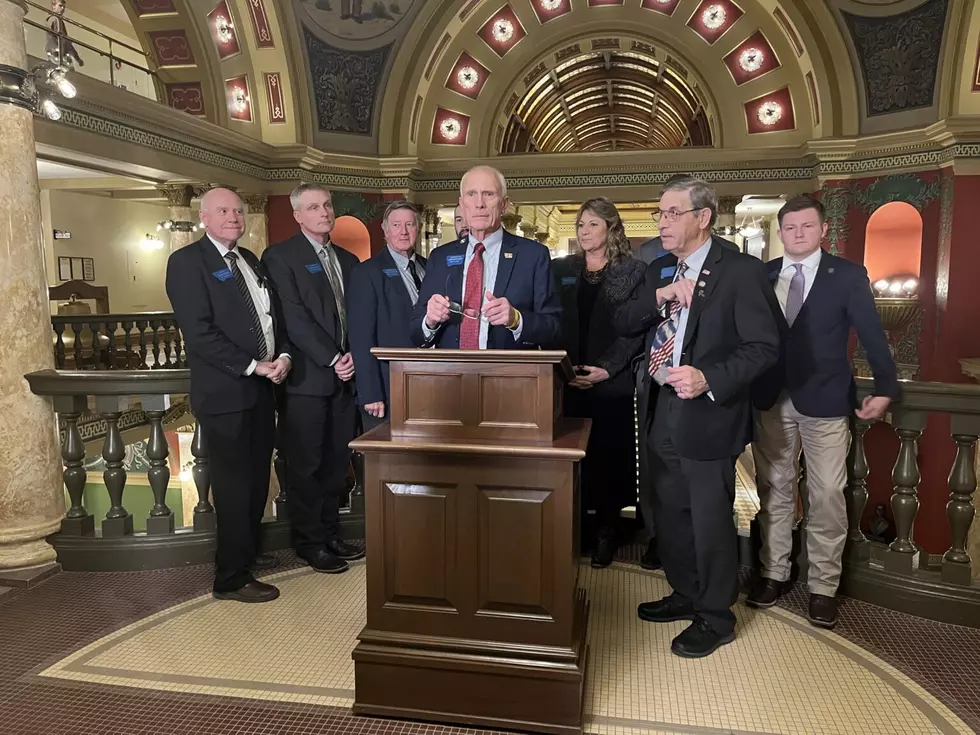
Montana Freedom Caucus defends push to steer state money to private company
Keila Szpaller
(Daily Montanan) Montana Freedom Caucus Chairman Jerry Schillinger tried to direct $600,000 of state money to a private company even after it lost the bid for a state contract.
The contract, to provide training for post-traumatic stress disorder therapy, came from House Bill 832 in the 2025 session of the Montana Legislature.
A public records request by The Daily Montanan uncovered the effort to steer the money to Quresta.
Quresta is based in New York and describes itself as offering a “life-changing” PTSD treatment without medication.
HB 832 called for a competitive bidding process, and records show Quresta was rated last among the three companies that submitted proposals.
In an email to the Montana Department of Labor obtained in the public records request, Schillinger argued the state should ignore the results of the competitive process and give the contract to Quresta anyway — or to no company at all.
Schillinger, a bill sponsor, defended the email last month in an interview with the Daily Montanan. The Republican from Circle said legislators intended the money to go to Quresta.
Bill drafting documents show Rep. Ron Marshall, who originally requested the bill, and Larry Anderson, a former county commissioner who worked on the legislation, wanted to fund the treatment by Quresta. But even in draft form, the bill called for a competitive selection.
“I think it’s just a shame that as promising as that treatment method sounded, it’s not going to get an opportunity to be tried here in Montana,” Schillinger said.
Correspondence obtained in the public records request by the Daily Montanan indicates the request from a legislator about a preferred vendor isn’t unusual.
In an email about Schillinger’s request, Department of Administration Director Misty Ann Giles told the Department of Labor commissioner and officials from the governor’s office “it is worth noting, I get these calls often.” Giles said if Schillinger had wanted a specific company to do the training, that information should have been included in the bill, but it wasn’t.
“While we want to have good working relationships with the legislature, it is not our job just to keep everyone happy when doing so violates the law,” Giles said in the email.
Bill sailed through the 2025 Montana Legislature
Anderson, a former Missoula County Commissioner and Vietnam War veteran, told the Daily Montanan the idea for the bill came when he read an American Legion article about treating PTSD without medication.
The treatment is called the RTM Protocol, or Reconsolidation of Traumatic Memories Protocol. It aims to help patients change the way they store memories in three-to-five 90-minute sessions so they don’t “relive” a traumatic experience.
The U.S. Department of Veterans Affairs says there is insufficient evidence to recommend it, but a clinical study showed patients who underwent the therapy reported fewer PTSD-related problems.
Anderson said he was impressed with the results, and he connected with a representative of RTM Global. In 2026, Quresta registered in New York to do business as RTM Global.
Montana has a high rate of veterans. U.S. News and World Report ranks the state No. 3 with nearly 9% of the population having served in the military.
House Bill 832 appropriated $600,000 to train health care providers in therapy for PTSD. It passed with strong support. Just seven legislators opposed it in its final vote in the Senate.
As head of the Freedom Caucus, Schillinger typically advocates for fiscal conservatism and limited government. In this case, he said he believed the money was worth spending compared with the social and criminal costs of letting PTSD go untreated, especially given testimony from the company.
“The results that they had documented were phenomenal. It just seemed like it would be ridiculous to not give that a try,” Schillinger said.
Quresta loses bid, Schillinger fights for it
On Dec. 24, 2025, the Department of Labor and Industry announced it planned to award the contract to a different company, Scaling Up LLC, of Utah.
Scaling Up also describes itself as offering a treatment that helps clients process difficult experiences and heal from trauma. In a scoring summary, evaluators praised both companies for different aspects of their programs, but Scaling Up’s proposal edged out the other two, in part because it proposed a cost $60,000 less than Quresta.
In an official protest of the award in January 2026, CEO Mark Ackermann of RTM Global, formerly Quresta, argued the state hadn’t properly evaluated the proposals, and he asked the Department of Administration to take “corrective action.”
In January and again in March, Schillinger stepped into the debate.
In an email to Department of Labor and Industry Commissioner Sarah Swanson obtained in the public records request, he said the contract needed to go to Quresta, “the only company to make a presentation to the Legislature.”
He said the program it offers has the potential to “deliver life altering and life saving help,” and fellow legislators agreed with him as evidenced by their votes.
“If for some reason the Administration feels constrained from awarding the contract to Queresta (sic), I would urge that no contract be awarded, no taxpayer money be spent on a program that received no hearings, no votes and no legislative support,” Schillinger wrote in the email.
An email in March shows Swanson sought guidance from other state officials, Giles of the Department of the Administration, and Ryan Osmundson and Mark Blasdel in the governor’s office.
Giles shot back a message that said Schillinger was unequivocally in the wrong, and the Department of Labor and Industry must go with the winning vendor, as she had advised in January.
“As a baseline matter, the legislature has zero authority to dictate that the executive (or judicial for that matter) select a particular vendor for any action. Period,” Giles wrote, bolding and underling part of the message.
Giles said the state ran a request for proposals, the competitive process ran without errors, and the state made the award to the winning vendor, not the “subpar” one Schillinger preferred.
“If you opt to attempt to cancel the RFP, we will require documentation and a legislator being mad is not a valid reason,” Giles said.
Giles also said if DLI tried to cancel the RFP, the company that won the contract would protest, and the state wouldn’t have a solid case in court “as the underlying reason that we are catering to a legislator will come to light.”
Complaint filed
Republican Rep. Ken Walsh believes the process still needs scrutiny. He filed a complaint with the Legislative Audit Division in June after learning about the push to send state funds to the company that hadn’t won the bid.
“This post-passage lobbying to circumvent a competitive process in favor of a company registered by a high-ranking party official raises serious questions regarding the legislative intent and the integrity of the procurement,” Walsh said in the complaint that he also sent to the Daily Montanan.
By state statute, the Legislative Auditor is charged with investigating lawmakers’ concerns but cannot release information about a pending complaint or acknowledge an investigation.
Walsh said last week the Legislative Audit Division said it does not believe the issue is waste, fraud or abuse, and recommended he refer the complaint to the House Ethics Committee instead.
“I think there’s more to the story,” Walsh said.
In a brief follow-up phone call, Schillinger said he will withstand any scrutiny. “I didn’t do anything wrong,” he said.
Ackermann said no one in Montana has a financial interest in the company.
Quresta has an active business license with the Montana secretary of state registered in November 2025 by The Montana Law Company, operated by Montana Republican Party Chairman Art Wittich.
It is not unusual for a lawyer to be asked to register a business for an out-of-state company.
In an email last month, Wittich described Walsh’s complaint as a “baseless, politically motivated whine from a sore loser.” (Walsh lost his primary election in June.)
Wittich also said that his involvement with Quresta is part of his business as an attorney, not his volunteer role as the leader of the state’s most powerful political party.
In a brief exchange in June at the state GOP convention in Missoula, Wittich told the Daily Montanan he wasn’t familiar with Quresta. He declined to clarify his response when reached by email in July.
Schillinger said he didn’t know that Wittich was involved until a few weeks ago when he learned about the complaint.
Walsh told the Daily Montanan he isn’t jumping to conclusions about this case.
“If everything is above board, that’s fine,” Walsh said. “But I think there’s enough questions there that should be answered.”