
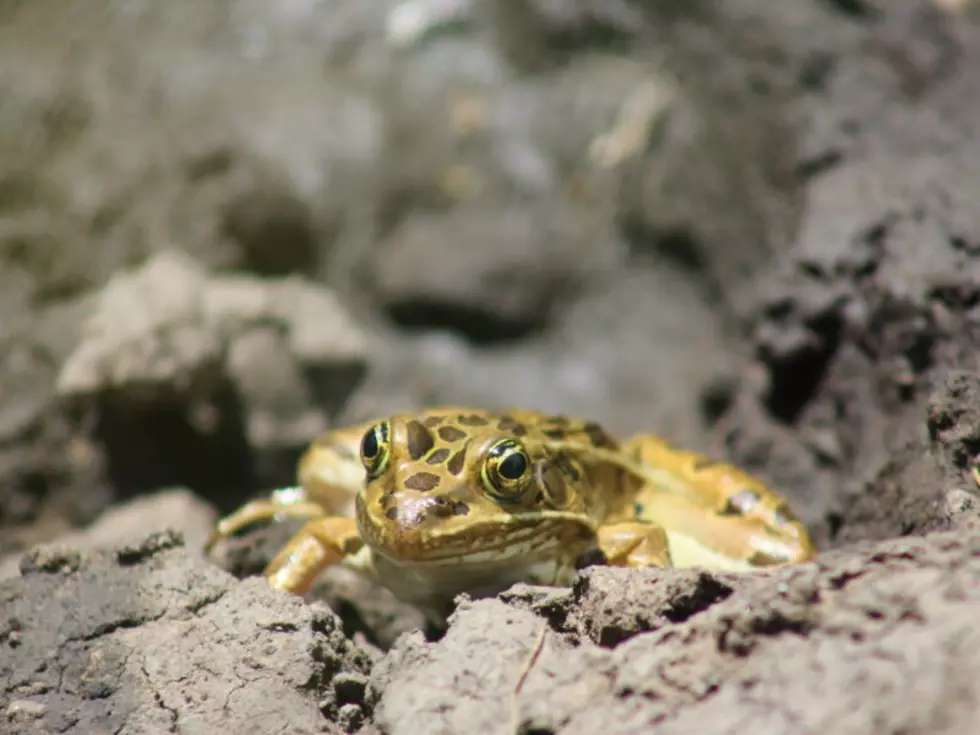
Northern leopard frogs find new home in Arizona rim country
Joe Duhownik
Payson, Ariz. (CN) — More than 100 northern leopard frogs splashed into new waters Tuesday, making their home along an ephemeral stream in northern Arizona recently renovated to establish a permanent wetland.
Arizona Game and Fish hopes the new wetland on Dye Ranch, northeast of Payson, Arizona, will help establish a new healthy northern leopard frog population and provide habitat for a host of other species that live along the Mogollon Rim.
“The northern leopard frog is really imperiled,” biologist Audrey Owens said Tuesday afternoon as she walked along Dye Ranch. “They used to be across all of the northern half of the state. Now we’re down to just very few populations.”
Between climate change, long-term drought, the proliferation of invasive species like crayfish and bullfrogs and the deadly chytrid fungus, northern leopard frogs have been designated by many state agencies as a species of special concern, despite a lack of federal listing as threatened or endangered.
“We’re doing what we can to identify areas where we can release them into the wild,” Owens, Game and Fish’s Ranid Frogs Project coordinator, said.
Luckily, Dye Ranch is a perfect candidate for a new population.
The one-mile-long parcel is defined by an ephemeral stream that flows from the Little Colorado River watershed into Alder Creek, which eventually drains into Roosevelt Lake. Historic cattle grazing and decades of erosion had compacted the soil and created deep vertical cuts in the ground, allowing water to move too quickly over the land and continue cutting deeper into the channel.
Game and Fish contracted with Wetland Restoration and Training LLC and Bat Conservation International to slow the flow of water using rock structures and underground clay dams, allowing the water to spread over the land and establish four permanent pools.
The teams completed the renovation in 2024, but a historically dry year kept the pools empty in 2025, so Game and Fish was forced to wait a year to introduce the frogs.
“It was kind of like the worst conditions we’d ever seen,” Owens said.
Monday night, a team of interns caught more than 400 frogs from refuge ponds on the Kaibab Plateau, the southern edge of which makes the northern rim of the Grand Canyon. Owens’ team transported the frogs in Rubbermaid containers stored in coolers to slow their metabolism and reduce stress during transport.
After allowing them time to warm back up, Owens and Game and Fish Wildlife Manager Abby Coleman released 120 frogs into two of the four newly-established pools.
The frogs took to the water immediately. Within minutes, some began eating vegetation along the bank while others swam across the pools and back to explore their new habitat.
Elk tracks line the banks of the pools, and birds, lizards, snakes and other amphibians have already settled in.
Owens found a terrestrial garter snake on the waters edge, commenting that it will be excited to have more prey in the area.
Coleman said they’ll have to return to the site soon to survey how many frogs survived the initial release. Owens said they will have to release more frogs to ensure the health of the population, at the end of this year if the monsoon proves strong or after winter if the so-called Super El Niño proves underwhelming.
Initial surveys of the wetland show no signs of invasive species, though Coleman said she’s seen crayfish in Alder creek where the stream empties. They can be found in most permanent waters in the region.
“They just wreak havoc,” Owens said. “They eat everything. Vegetation, algae, tadpoles. If they can catch a frog they’ll eat a frog.”
Swabs of other amphibians at the site, like tree frogs and tiger salamanders, show no signs of chytrid fungus, though Owens and Coleman remain wary.
Chytrid first evolved in East Asia and moved to the Americas in the 1800s, where amphibian species were not evolved to handle the diseases it causes. Owens said some species in California have shown signs of an evolving immunity, but Arizona’s frogs have not yet developed a resistance.
“There’s hope, but we just have to keep putting frogs on the ground so they can get exposed to it,” she said.
The fungus — which affects the frogs’ skin, impacting their ability to breathe, hydrate and thermoregulate — thrives in the winter, so this group surviving the winter will be the first significant benchmark toward a stable population.
Northern leopard frogs are especially susceptible to chytrid fungus because they breed in the spring and their tadpoles turn to frogs before the winter. Tadpoles typically aren’t susceptible to the fungus, meaning even if it wipes out all the adults over the winter, the tadpoles will survive into the next year. In the case of the northern leopard frogs, the fungus can wipe out an entire population at once.
“I’ll be holding my breath and coming out here probably in April to see if the frogs survived the winter,” Owens said.
The next benchmark would be successful reproduction. Coleman said she’d be happy to find “just one tadpole” as evidence that the population is breeding. Finally, the pools holding water through the next summer will be a sign of long-term success.