

$67M affordable housing project planned for Midtown property
Martin Kidston
(Missoula Current) A team of local developers in partnership with the city on Tuesday announced plans to construct nearly 200 units of affordable housing on property the city purchased from Montana Rail Link eight years ago.
Dubbed Franklin Crossing, the project remains contingent upon the receipt of 9% Low Income Housing Tax Credits from the Montana Board of Housing later this year, among others – an application process that's grown increasingly competitive in recent years.
But to help sweeten the project's application, the Missoula Redevelopment Agency on Tuesday approved a request from the city to reserve $9.7 million in tax increment from Urban Renewal District III.
Missoula Mayor Andrea Davis said the city pivoted quickly when the project team brought the proposal forward, given the timing of state financing made available by the Legislature.
“We're requesting MRA put a placeholder in URD III in order for there to be the reservation of funds showing our commitment,” Davis said. “When the project partners can put forward a competitive proposal showing the city has such substantial skin in the game, it increases our chance of getting funding. This is a very competitive process on the state level. Affordable housing is needed in every corner of our state.”
As proposed, the project would include 192 apartments reserved for those earning between 30% and 70% the area median income. The units would include one, two and three bedrooms collected across three separate, five-story buildings.
The city will donate land to that portion of the project and provide the $9.7 million to help bolster the tax credit application. The project serves as a partnership between the city, the Missoula Housing Authority and United Housing Partners.
“There are 17 different sources of funding to make this project work. It's not the way we want to do it, but it's the way we have to do it,” said Tyson O'Connell, founder of United Housing Partners.
“In order to make this happen, we have to cobble together a number of different resources. The city's investment in this is the biggest part. We want to go to the Board of Housing and look at the board and say that Missoula has given us the reservation of more than $9 million, contingent upon us getting the 9% Low Income Housing Tax Credits. That goes a long way because there's a lot of projects competing for those 9% credits.”
The land and vision
In 2017, Montana Rail Link agreed to sell roughly 12 acres off Johnson Street and North Avenue to the city for $2 million – less than the property's true value at the time. The city followed by constructing MRL Park on four acres, leaving eight acres reserved for future redevelopment.
But when the pandemic hit, the city converted one of the property's remaining structures into an emergency winter shelter. That irked area residents who believe the city went back on its intention to redevelop the dilapidated property.
The City Council in 2024 however passed a resolution calling for the shelter's closure and deconstruction. It also directed the city to begin plans to redevelop the property within three years. Davis said the current proposal meets the city's initial intent when it bought the property from the railroad.
“This parcel has long been under the redevelopment planning process,” Davis said. “We have this opportunity here on MRL Triangle to provide deed-restricted affordable housing with a very diverse number of incomes and home types, and opportunities for market-rate home ownership. This hits the mark in a number of different ways.”
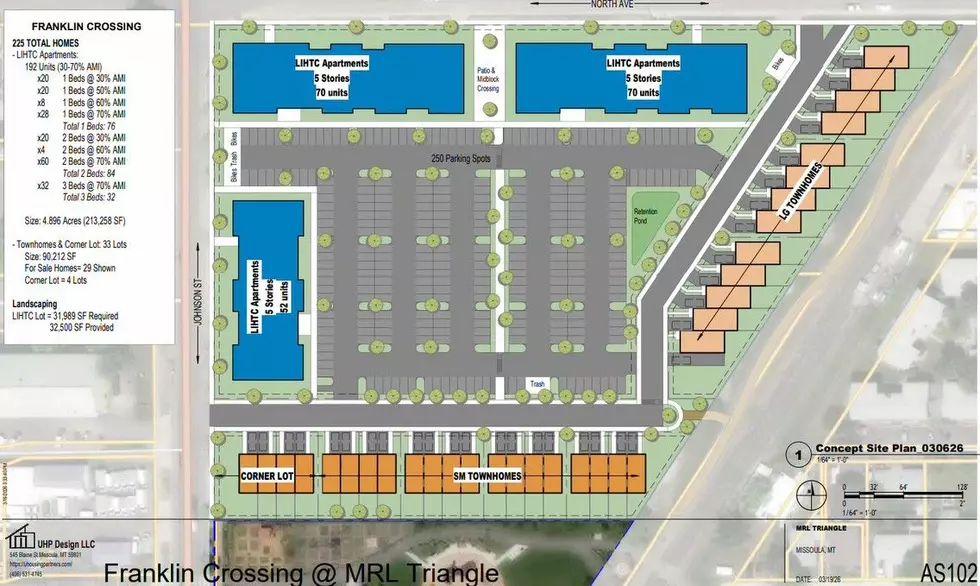
Along with the 192 units of deed-restricted housing, United Home Partners also plans to construct roughly 33 townhomes along the Bitterroot Branch Trail, which will be sold at market rate. Davis said that project remains separate from the 9% tax application process and would be carried out solely by the private sector.
“We will not be contributing public dollars to the market-rate housing,” said Davis. “United Housing Partners will buy that land directly from the city and work with the private sector to build those market-rate homes.”
Apartment breakdown
MRA Director Ellen Buchanan said that 60 units within the deed-restricted housing project will be reserved for those earning between 30% and 60% of the area median income. The remaining 132 apartments would serve those earning between 60% and 70% of the area median income.
That brings the subsidy to roughly $51,000 per door, something Buchanan described as a value in today's market. She placed the value of the city's land donation at around $3.2 million while the cost of the public project stands at nearly $70 million.
Of the $9.7 million in MRA funding, roughly $3 million is reserved for infrastructure needs and $6 million to cover the cost of subsidizing the apartments.
“What we're trying to do is demonstrate to these other funding sources the commitment the city has to this project,” Buchanan said. “It's going to go a log ways for our development team to secure the needed 9% Low Income Housing Tax Credits.”
Buchanan said Urban Renewal District III has the capacity to cover the $9.7 million funding reserve without issuing debt. If the project receives the state tax credits, it would likely break ground in 2028.
“Once the tax credits are secured, there's still 10 months of work that has to be done before closing and groundbreaking and all those things,” she said.