

Missoula County releases data center study, considers next steps
Martin Kidston
(Missoula Current) A study conducted by Missoula County found that data centers can have a significant impact on health, safety and the environment, and the interim zoning adopted earlier this year pausing any new development was appropriate.
County officials released the findings of the study on Monday, roughly four months after adopting an interim ban on new or expanded data centers. What happens next hasn't been determined, though it won't likely include an outright ban on such facilities given current state law.
But the study does recommend the county begin drafting new zoning regulations to address a range of known impacts. It also calls for the county to lobby both the Legislature and the Montana Public Service Commission to protect its right to make decisions on zoning and land use.
“We definitely don't want to wait,” said Svein Newman, the county's climate action program manager. “Some of these things we can probably knock out fairly quickly, like noise. But there are some impact areas that we haven't seen other communities address so much like back-up power and generators. It's a tricky one in a constrained authority space.”
Study findings
The study identified three types of data centers including hyperscale – the largest – along with multi-tenant facilities that use shared equipment and enterprise-scale operations.
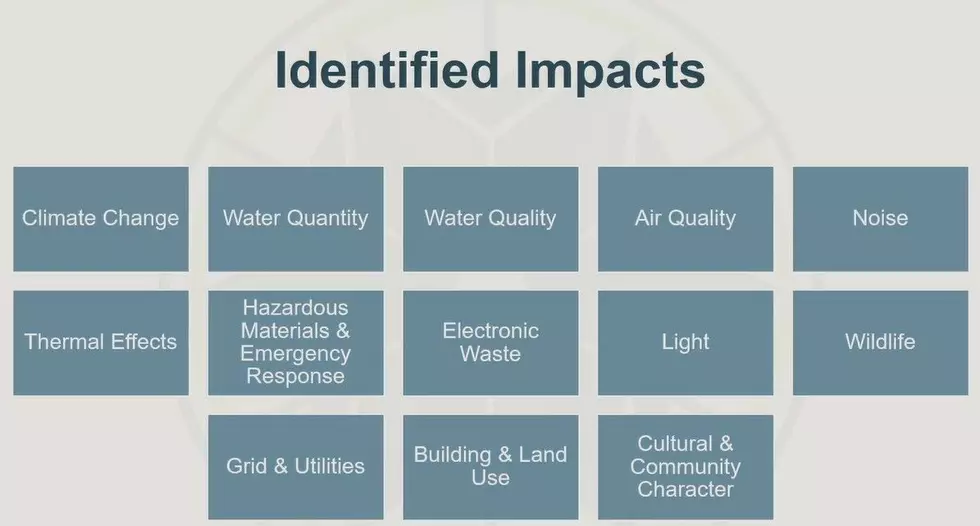
The study also identified 13 potential impacts including climate change, water quality and quantity, noise, thermal effects, land use, electronic waste, wildlife and light pollution, among others.
“We're not saying that every data center is going to have all these impacts, but data centers can have some of these and in different combinations,” said county planner Patrick Swart. “Even on the smaller end, there can still be some pretty significant impacts.”
The county believes the average data center stands at roughly 40 megawatts – the equivalent energy used by every home in Missoula County. Even a 10-megawatt facility would consume the power used by thousands of Montana homes.
Such power consumption comes with costs.
“Water quantity is probably what we heard the most,” said Swart. “The study confirmed that data centers can use a lot of water, but that doesn't necessarily have to be the case. A lot of that is dependent on certain technology choices.”
According to the study, the most common water use among U.S. data centers is evaporation cooling, where roughly 80% of water input is lost to evaporation. While closed loop or immersion cooling can lower water consumption, it may also suck more energy.
Water quality is also a concern, Swart said. The study found that water input is often mixed with ethylene glycol, biocides and corrosion inhibitors. Issues of discharge, storage and spillage are a concern, though the county's ability to regulate such issues locally may be challenging.
“We still need to parse out to some degree what authority the county has or can have relative to the state,” said Swart. “There are some impact areas we've found where the county has some authority, and there's some impact areas where we're preempted and the state has claimed that. Water quality is probably one of the ones where the state has more purview.”
Air quality associated with backup generation also surfaced as a concern in the county study. Even a few seconds of power loss can result in data loss or corruption. As a result, data centers are generally designed to have built-in redundancies to protect the system.
The average data center uses diesel generators to accomplish that task, the study found. While the county could address noise and set backs through zoning, regulating issues like fuel storage, fuel spills and air quality may fall to the state and the Montana Department of Environmental Quality.
“We really want to drill down to what extent Missoula County has the authority to directly regulate those, or get at those concerns some other way,” said Swart. “That's one of the big questions floating around air quality.”
Right to regulate versus state law
Data center energy use could eventually consume between 9% and 15% of the nation's total electricity by 2030, according to the Berkeley National Laboratory.
And while natural gas is the most common source of fuel used to power data centers, the facilities can be fully powered by clean electricity. The study suggests that many companies have set such goals, though they cannot be guaranteed with policy requirements, such as that adopted by Missoula County.
“Missoula County already has required 100% new or renewable energy for data centers or crypto-currency mines,” said Newman. “We fully expect it to be part of our proposal if directed to update our zoning regulations. We think it's one of the most important impacts data centers can have.”

County officials said that whatever steps the county takes to regulate the industry could be aided or hindered by the Legislature, which convenes in January. Already, county officials have found more than a dozen bills directed at data centers, though the bill language isn't yet drafted.
The study also looked at Montana's existing policy, which includes a “Right to Compute Act.” But state law also gives counties the right to adopt land-use and zoning regulations to protect public health and safety, creating something of a legal gray area.
The study recommends the county stay engaged with both the Legislature and the PSC.
“The county should consider getting involved with data-center issues at the Legislature. That's where a lot of the decision-making authority lies,” Newman said.
While the Legislature convenes in January, the study suggests the county begin drafting zoning regulations but not complete them fully until the session is finished.
“We have not seen bill drafts yet,” said Karen Hughes, director of county planning and development. “We know generally that this seems to be a hot topic across Montana, and there seems to be interest in being able to reasonably regulate. We're still early in the pre-legislative process.”