
Harmon’s Histories: And that’s a wrap for the venerable Jim Harmon!
Jim Harmon
I find it impossible to fathom, but I am quickly approaching my 80th birthday! Strange how those sorts of things sneak up on you.
I have loved the 10 years I've spent writing about the news of yesteryear for the Missoula Current.
But having done about every story that ever piqued my interest, it is becoming harder to find fresh material. In addition, my wife and I are wanting to slow down and smell the roses.
With that, today’s submission is my last under the banner of Harmon’s Histories. I’ll still do a story every now and then when something catches my eye, but the weekly column shall now rest in peace.
Let’s take a ride in the old time machine and visit some of the places we’ve been and things we’ve seen over the last decade. Of course, I always prefer the humorous subjects.
Ten years ago, we learned of a terrible murder – the murder of a mouse by an alligator!

No matter the year, as you read Montana's old newspapers, it's easy to find a chuckle. One of my favorite advertisements was for the services of a Missoula undertaker who would sell you a set of furniture or a bicycle, then embalm and bury you.

Then there were the wonderful newspaper columns written under the nom de plume (pen name) of Violette Gleamer, “(an) estimable young lady of this city who will attempt every Saturday to dish up society as she finds it in Missoula, writing of it in her own particular manner.”
The columns were a satirical jab at the crosstown Western Democrat newspaper’s stuffy social columns on the city's “swell set.” While it was widely believed the author was the Missoulian’s city editor, he repeatedly denied it.

Montanans certainly liked to give our cities and towns nicknames. In Leeson's "History of Montana 1739–1885," examples were "The Magic City" for Billings, "The Queen of the Mountains" for Helena, "The Beautiful City" for Bozeman, "The Silver City" for Butte and "The West Butte City" for Missoula.
Ravalli County, for a time, was called the "Baby County" (chiefly by the Missoulian newspaper) after it split off from Missoula in 1893.
In August 1895, penniless and in ill health, Samuel Langhorne Clemens (aka, Mark Twain) visited Missoula and Helena on the first leg of a two-year international lecture tour to generate money to repay his creditors.

Coyote Bill captured my attention, and was featured as the title character of my book, "The Sneakin'est Man That Ever Was," a few years ago.
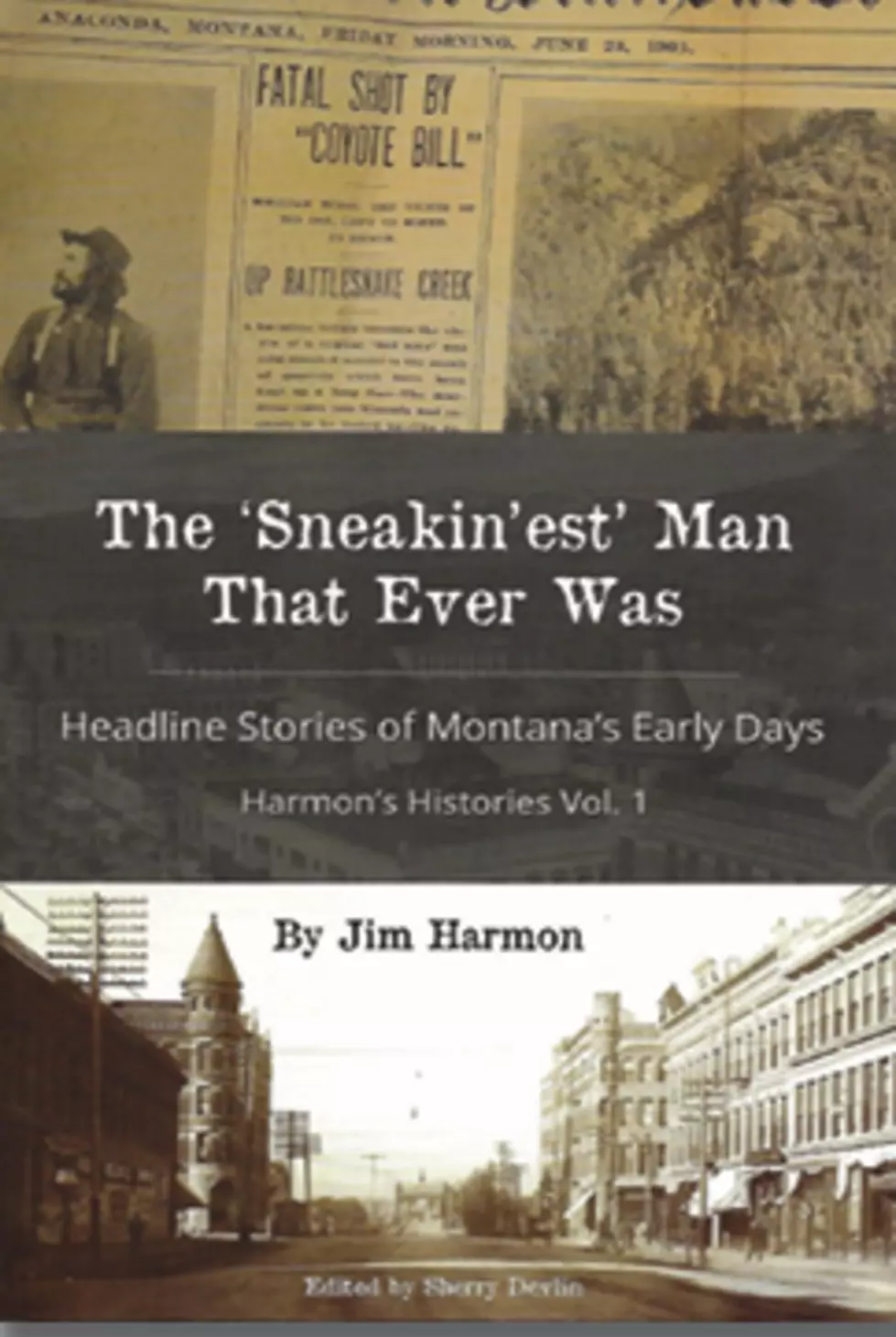
He was known alternately as K. E. W. Beeskove, William F. Beeskove, and Colonel Coyote Bill. Most people just knew him as "Coyote Bill," the old guy who lived up the Rattlesnake Valley.
He was a hunter, trapper and miner who claimed to have been a scout for Gen. George Armstrong Custer. He was married five times, in one case, placing an ad in a matrimonial publication before his latest divorce was finalized.
He certainly wasn't very neighborly. One man had him arrested on an insanity charge, but it didn't stick. Another had him arrested for blocking a bridge with a rifle. The disputes escalated to the point a couple of men beat him severely, then burned his cabin to the ground.
His irascible nature finally got the best of him. In a 1905 confrontation, he murdered William Burrig for cutting firewood on what he claimed was his property.
After seven years in prison Coyote Bill relocated to Dixon where he established an orchard and did some mining. In 1916, after claiming to have struck gold, he was found dead, face down in a creek with his throat cut. Some said it was suicide; others weren't so sure. He was 72.
Then, there was the kangaroo in St. Regis.
"Shortly after midnight I was awakened by a cold breath on my burning cheek, and sitting up beheld, to my horror, a huge kangaroo hopping around the room.

"The animal must have measured, when standing erect, fully 11 feet in height. His tail as it wound around the little room, could not have been less than 19 or 20 feet long; his ears, sticking up like a government mule's, were certainly not less than 2 feet in their extreme length; and the sharp, glistening toenails, for which these animals are famous, were in this instance fully 9 inches in length and seem to me to possess the strength of a woodman's axe.
"The night was a cold one, and by a superhuman effort, I managed to hold on against the superior strength of the animal, until its tail froze solid and broke off, when the animal bounded away into the darkness of the night, and I fell back on the floor, limp and faint."
A story I became personally involved with was that of one of the earliest grand pianos brought to Missoula (circa 1880). It had no public home, no place to be displayed and appreciated by Missoulians.

It was a Hazelton Brothers (New York) square grand piano, once owned by city co-founder Frank Worden.
The owners, Worden family descendants, wanted to donate it to an institution willing to display it, and were even willing to pay the expenses to ship it back to Missoula.

After I wrote an article about it, Thomas Taylor, who purchased Missoula’s Florence hotel in 2017, offered the piano a prominent place in the in the mezzanine of the downtown landmark. I encourage you to visit the Florence and see the wonderful “square grand.”
One of the saddest pieces I had to write was about Missoula Mayor John Engen’s cancer diagnosis. But I chose to feature John’s sense of humor as his legacy.

I wrote: As editor-in-chief of the high school paper “Hellgate Lance” in 1982, Engen wrote about “three facts of life: armpits, bellybuttons, and toilet paper.”
Armpits, he wrote, were “odd parts of the body, meaning they have no practical purpose other than a breeding ground for odor and/or lice.”
“There is not much fun stuff that you can do with an armpit other than make noises that sound like an expulsion of gas.”
As for bellybuttons, while admitting they served little purpose for most folks, he felt the navel was a most useful accoutrement.
“My bellybutton is rather large, and it is not uncommon for me to carry a donut or my books in my gut-button. Believe it or not, I have had offers from textile companies to weave the lint from my navel into fabric for John Engen designer jeans.” I sure miss John.
There are so many wonderful memories, and so many stories over the years: early telephones, the city bands, the glory days of the Fox theater, county fairs, love triangles, making my first crystal set radio, the C. C. C., Dunn Creek Nell, early fly swatters, and the wampus cat.
To Martin Kidston and Sherry Devlin, thank you so much for giving me the forum for my weekly writings. I’ve enjoyed our decade-long partnership.
So, while the weekly column will now rest in peace, I’ll see you now and then when a story catches my eye.