
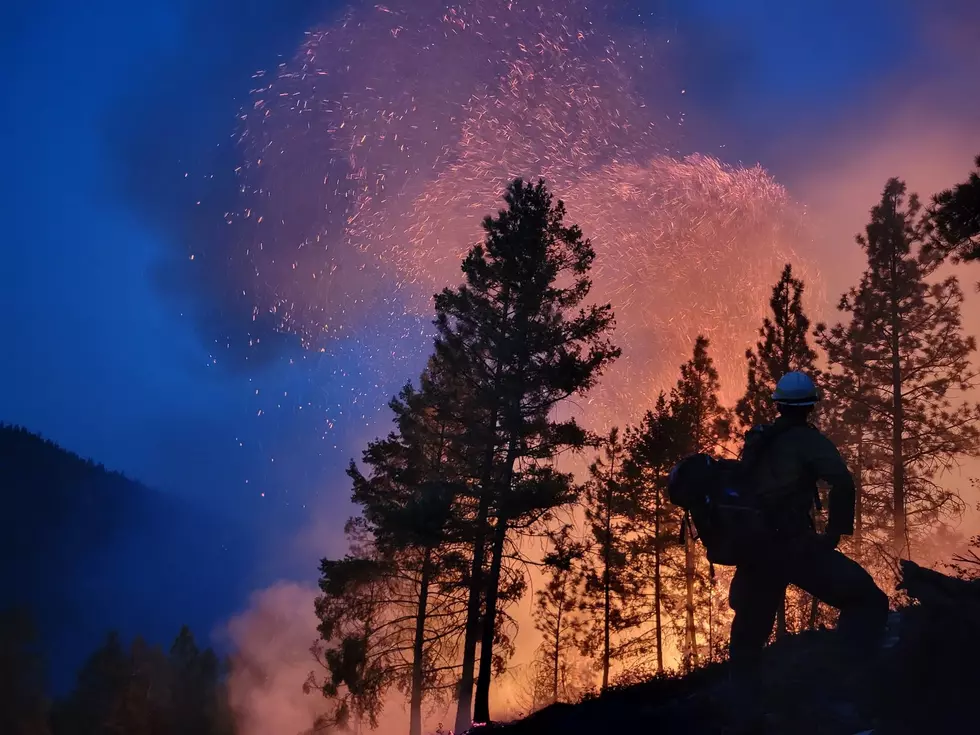
Red flag warning could cause small wildfires to flare
Laura Lundquist
(Missoula Current) The U.S. Forest Service is trying to hold a few regional fires at bay, but Saturday is predicted to bring weather that could put their work to the test.
The National Weather Service has issued a Red Flag Warning for Saturday from 2 p.m. through midnight. Winds of 15 to 25 mph with gusts up to 40 mph are predicted for much of western Montana from the Kootenai Forest over to Glacier Park and down through the Flathead Reservation to the Bitterroot Valley. At the same time, the air will be extremely dry with relative humidity down as low as 9% and temperatures are expected to top out at around 100 degrees.
Those conditions could lead to the rapid spread of wildfire and there are a number burning west of Missoula on the Lolo and Bitterroot national forests. So fire crews have been working hard to get those fires under as much control as possible. The helicopters thumping over Missoula are running water and firefighters to a number of fires.
The Elder 1 Fire along Rock Creek in the mountains south of Frenchtown has grown slowly since it was first detected on July 24 and is now more than 1,000 acres. A Northern Rockies Complex Incident Management Team 1 took over on July 28 and has taken advantage of mild weather conditions over the past few days to build fire lines and do some backburning.
In his briefing at 5 p.m. Friday, Operations Section Chief Justin Kaber said Friday had been a good day on the Elder 1, and crews had the fire 14% contained, mostly on the southeast side along Rock Creek Road.
“Saturday, the weather is going to be extremely challenging with critical fire weather coming in. We’re seeing high winds and low (relative humidities), so we’re getting plans in advance. If the fire leaves its current footprint, we’ll be able to respond appropriately,” Kaber said. “We’re positioned very well for a critical fire-weather day.”
On Thursday, two small fires were detected farther west. One - the Plateau Fire - is three miles west of Alberton and it was less than an acre Thursday afternoon. Another - the Big Hole Fire - is near the Big Hole Lookout 4 miles northeast of Eddy and was about 2 acres.
A few smaller fires flared up in the Ninemile and Superior ranger districts earlier this week, and although they were quickly contained, the winds may bring the flames to life again.

Down on the Bitteroot National Forest, a lookout spotted smoke on Thursday from the lightning-caused Coal Creek Fire, which had burned an acre 3 miles southwest of Painted Rocks Reservoir before it was contained. Another lightning-caused fire was detected in the high country 10 miles west of Victor when it was still less than an acre and helicopters took firefighters in. Then lightning on Thursday night started two more fires east of Hamilton but they were quickly contained. The Little Sleep Fire was detected midday Friday in the Little Sleeping Child drainage and had burned an acre in grass brush.
The North Fork Fire was detected a week ago Friday high on the slopes above the North Fork Lost Horse Creek. Since the terrain is very steep, it has been dangerous for crews to try to work. But as of Friday, it was still just 10 acres and crews are building fire breaks where they can.
Across the Bitterroot Valley in the Sapphire Range, about 24 miles southwest of Philipsburg, the Moose Fire has burned about 225 acres since it was detected on Sunday. There are a lot of dead and downed trees in addition to heavy logging slash in a historic burn area, according to InciWeb. So fire managers are using an indirect confinement strategy, relying on preexisting firelines, roads and trails and prioritizing structure protection.
Earlier this week, national forests, national parks, state parks and Missoula County raised the fire danger to “very high,” which means fires start easily from all causes, and immediately spread fast. Vegetation continues to dry out rapidly. Small fires can quickly become large fires and exhibit extreme fire intensity. These fires can be difficult to control and will often become much larger and longer-lasting fires.
Although some of the recent fires were started by lightning, agencies estimate that 80-90% of wildfires are started by people. They leave campfires unattended or don’t put them completely out when they leave; they drop cigarettes or ashes in dry grass, or park hot cars on top of dried vegetation. Sparks from trailer chains dragging on the road can start fires. So agencies ask that people be mindful of how their actions could lead to a fire.
Contact reporter Laura Lundquist at lundquist@missoulacurrent.com.