
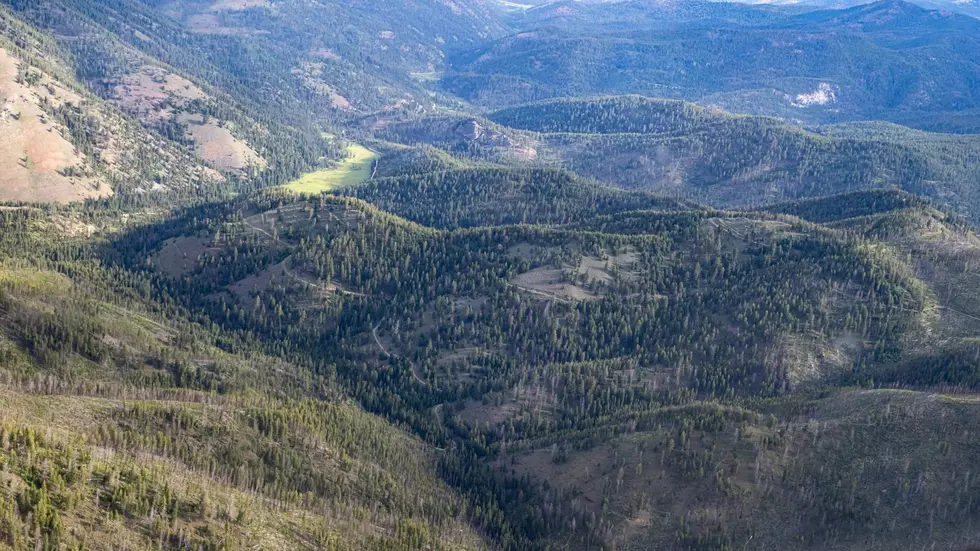
DEQ initiates scoping for controversial Sheep Creek mine
Laura Lundquist
(Missoula Current) Owners of the Sheep Creek mining claims are pushing forward with their exploration plans, even though a recent analysis shows that 98% of the public opposes the mine.
On Friday, the Montana Department of Environmental Quality announced it was soliciting comments from the public on the Sheep Creek Exploration project proposed by US Critical Materials Corporation. On Oct. 7, DEQ received an application for an exploration license along with a plan of operations that was updated in August from US Critical Materials.
Similar to a previous operations plan submitted on Dec. 5, the company still plans to sample or drill at four locations near the confluence of Sheep Creek and the West Fork of the Bitterroot River. Two of the locations are at former historical adits, or tunnel openings, where the company would enlarge the adits.
Drill pads would be installed at three locations with up to 16 holes per pad. The maximum depth of any one hole would be 1,000 feet, with the average being around 400 feet. At the fourth location, the company would enlarge the existing mine entrance so they can sample in the tunnel using explosives.
All four sites would be primarily serviced by helicopter flying out of Conner, about 30 miles away. The company would build wooden landing platforms at all four sites. Exploration activity will occur seven days a week, but nighttime operations are not proposed. The project is predicted to last roughly one year.
The operations will require sufficient water to lubricate equipment and control dust. Bulk sampling in the mine tunnel will require up to 300 gallons a day, which can be retained in a sump underground and recycled. Drilling requires up to 8,500 gallons a day, which will be recycled from a sump excavated at each site. A helicopter would hoist water from outside the project area to the project site as needed.
DEQ set no specific date for the end of public comment, saying only that it “will close when a draft environmental review has been released.” The public will be allowed to comment on the environmental review.
The Sheep Creek mine project sits on public land managed by the Bitterroot National Forest. Under the General Mining Law of 1872, holders of mining claims have a right to explore for minerals on federal lands. However, the Forest Service is required to analyze the Plan to set reasonable requirements for protecting surface resources. So the Forest Service already held its 30-day scoping period starting in mid-August.
Two organizations - American Rivers and Bitterroot Water Partnership - have since analyzed the public comments sent to the Forest Service. After going through 6,202 unique comments, American Rivers found only 14 supported the project as proposed.
The Bitterroot Water Partnership randomly sampled 125 comments and found 98% “were opposed to the Plan in its current form, if not the entire concept of hard rock mining in the headwaters of the Bitterroot River.” A similar percentage - 95% - asked the Forest Service to conduct an environmental assessment instead of using a categorical exclusion to sidestep public participation. Almost 90% of comments mention “risks to water.”
Groups like the Ravalli County Economic Development Authority, the Bitterroot Valley Chamber of Commerce and the Ravalli County Board of County Commissioners shared their concerns too.
“The Board of County Commissioners submitted a comment to the Forest, asking that they reject use of categorical exclusion for this Plan. There are enough extraordinary circumstances present that only a more rigorous review, an Environmental Assessment, would be appropriate,” Dan Huls, chair of the Ravalli County Board of County Commissioners, said in a statement. “The (Bitterroot River) not only irrigates our ag land but recharges our aquifer. What a travesty it would be if that irrigation infrastructure delivered poison to our ag lands, our animals, and our wells. This risk alone deservers an Environmental Assessment.”
In spite of public opposition, the exploration project will likely be approved because the Federal Permitting Council selected the Sheep Creek Project for FAST-41 permitting in December. Congress passed the FAST Act in 2015 to streamline the approval of federal transportation projects. But a year ago, the Trump administration started using the FAST Act to fast-track critical-mineral mining projects by limiting environmental review and reducing permitting requirements as part of Trump's American Energy Dominance program.
The Sheep Creek Project is one of five mine projects in Montana that have received FAST-41 permitting. As part of the FAST-41 program, the federal government provides US Critical Materials with insider advice and aid, including a project advisor to help with the permitting process and access to top agency managers including the Office of Management and Budget director and the Council on Environmental Quality chairman.
In 1953, deposits of rare-earth metals were discovered in the 7-square-mile Sheep Creek Columbite Deposit Mine Site, and the site has been studied and sampled since the early 1960s. But there was little demand until now.
“Rare earth elements,” are 17 elements, dubbed “heavy metals,” that have various electronic and magnetic properties that make them useful in an ever-expanding array of electronic components, magnetic materials, lasers, industrial processes and rechargeable batteries used in electric vehicles.
After some initial mineral exploration in 2022, U.S. Critical Materials Corp. announced in January 2023 that it had discovered “the highest-grade (rare-earth element) deposit in the United States” among its 223 mining claims near Sheep Creek.
To provide scoping comments to DEQ, go to the Sheep Creek announcement page.
Contact reporter Laura Lundquist at lundquist@missoulacurrent.com.